In 2026, foldable smartphones are no longer trade-show novelties. They represent a full-fledged category with an offering varied enough to address very concrete needs. Two form factors coexist: the "book-style" model, which opens like a notebook to reveal a tablet-sized screen, and the "flip" model, which folds down into a small square. Behind these two designs lie distinct promises and vastly different user profiles.
Rather than yet another spec sheet, here is a breakdown by real-world use: who genuinely stands to gain from taking the plunge, for what purposes, and at the cost of which trade-offs. From seniors and power users to road warriors and daily commuters, there is a case to be made for everyone—provided you choose the right format. We will also cover the remaining limitations pointed out by reviewers, and how to lower the bill by buying refurbished.
Sommaire
- Two Form Factors, Two Philosophies
- Seniors and Eye Strain: Reading Comfort Above All
- Tight Pockets, Small Bags: The Clamshell Comeback
- Taxi Drivers, Ride-Hailing, and Road Warriors: A Large-Format GPS
- Daily Commuters: A Pocket-Sized Cinema
- Work Meets Play: Blurring the Lines
- Trade-offs to Consider Before Buying
- How to Choose (and Save Money)
- Conclusion: The Right Foldable Fits Your Everyday Routine
Two Form Factors, Two Philosophies
Before diving into user profiles, it is essential to understand what sets the two families apart. The book-style (or "Fold") format features an inner display measuring around 7.6 to 8 inches, depending on the model. Once shut, it remains a fully usable smartphone thanks to its cover screen. Prominent devices in this category include the Samsung Galaxy Z Fold7 Dual Sim Blue / 512 / Very Good Condition, the Google Pixel 10 Pro Fold 512GB, and the Honor Magic V6 512GB.
The flip (or clamshell) format plays an entirely different card: compactness. When folded, it takes on a square footprint roughly 85 mm on each side, paired with an outer screen often close to 4 inches. This is the domain of the Motorola Razr 70 Ultra 512GB and the Motorola Razr 60 Ultra 1TB. Reepeat's catalog also includes the Apple iPhone Duo 2TB: check its product page for full technical specifications before comparing it with alternatives.
The Darty buying guide captures this dichotomy nicely. The flip format lets you carry a large display within a pocket-sized device when closed. The book format suits those looking to merge smartphone and tablet into a single productivity and media-consumption machine. These dimensions serve as general benchmarks: they vary from one manufacturer to another, so always verify the detailed specs of your shortlisted model.
Seniors and Eye Strain: Reading Comfort Above All
This is arguably the most underestimated advantage. An inner screen of 7.6 to 8 inches fundamentally transforms reading on mobile. For individuals experiencing declining eyesight or digital eye strain, font sizes can be enlarged significantly while keeping an entire page readable—unlike standard phones, which force continuous zooming and panning.
The day-to-day benefits are tangible:
- Administrative documents: tax notices, certificates, and PDF statements are displayed at a scale close to a reduced physical page.
- Family photos: pictures can be viewed in large format without needing to pinch-to-zoom to see faces clearly.
- Messaging and email: larger text remains comfortable, with more lines visible at a glance.
- A single device: no need to buy or carry a dedicated tablet on the side.
A practical tip: right after setup, head into the accessibility settings to increase text and display sizes, then test them under real-world conditions. Be sure to try opening and closing the hinge as well, as ergonomic comfort matters just as much as screen size. Keep in mind that reviewers consistently note the central crease remains noticeable from certain viewing angles: on a plain white page, some users will be more sensitive to it than others.
Tight Pockets, Small Bags: The Clamshell Comeback
At the opposite end of the spectrum, the flip format solves a different everyday frustration: sheer bulk. Standard smartphones have grown so large that they rarely fit into jeans pockets or compact handbags without stretching the seams. When closed, a flip phone forms a square measuring about 85 mm across: it slips effortlessly into an evening clutch, jacket pocket, or small crossbody pouch. You carry a full-sized display whenever you need it, and a tiny object the rest of the time.
For connected users, the cover screen—frequently around 4 inches—is the real game-changer. As noted by the Darty guide, its touch capability allows quick management of notifications and messages without ever opening the device. In practice, you can:
- Reply to a message or check your calendar with a quick gesture;
- Make contactless payments;
- View handy widgets or control music playback;
- Snap selfies using the main rear sensor, which outperforms conventional selfie cameras.
This setup also encourages a healthier digital routine by reducing passive screen time. Because the phone remains closed most of the day, you handle essentials without falling down endless social media rabbit holes. Models like the Razr 70 Ultra or the Razr 60 Ultra are aimed squarely at users who want to stay reachable and efficient without hauling around a digital brick.
Taxi Drivers, Ride-Hailing, and Road Warriors: A Large-Format GPS
Driving professionals—including taxi and ride-hailing drivers, as well as field sales reps spending entire days on the road—have turned the book-style foldable into an essential work tool. Unfolded, the large screen doubles as a true large-format navigation hub. Split-screen view lets you display live navigation via Google Maps or Waze on one side and a dispatching or dispatch app on the other, eliminating the hassle of constantly switching between tabs.
The same logic applies to frequent long-distance drivers who appreciate a secondary GPS feed: monitoring an alternative route, running live traffic or EV charging station locators, or keeping a detailed map visible at a single glance without constantly flipping back and forth.
A few precautions are worth noting:
- Use a secure car mount designed specifically for the dimensions of the phone when unfolded, or for its folded footprint. Check compatibility prior to purchase.
- Set your destination while safely parked: holding a phone while driving remains strictly illegal in many countries.
- Keep an in-car charger plugged in. Navigation keeps the display awake continuously, and reviewers widely agree that large unfolded panels exert substantial demands on battery life.
A flagship device such as the Galaxy Z Fold7 or the Pixel 10 Pro Fold fits naturally into this kind of mobile workstation setup.
Daily Commuters: A Pocket-Sized Cinema
For daily commuters spending thirty minutes to two hours on trains, subways, or regional rails, the book-style foldable is a standout travel partner. Once opened, the inner panel delivers an experience far more immersive than any standard smartphone for streaming high-definition shows and movies. It is equally suited to reading digital newspapers, rendering articles in readable columns reminiscent of an e-reader or tablet.
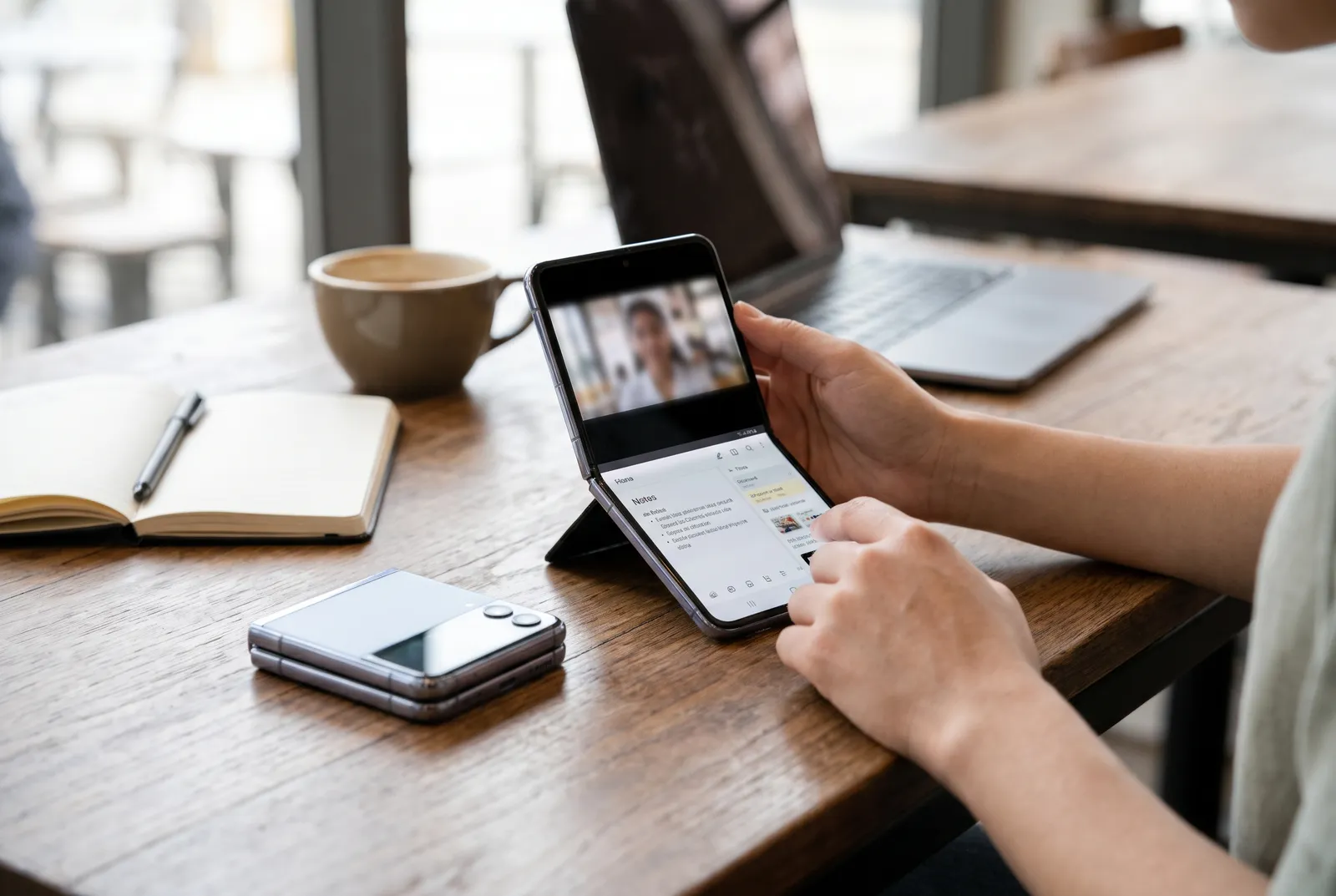
The appeal is twofold. First, it replaces the tablet or e-reader that previously weighed down your commuter bag, leaving only one device to charge. Second, semi-open positioning (often known as Flex Mode) allows the phone to rest securely on a tray table without requiring a kickstand or tripod—ideal for hands-free viewing on a train journey. The Darty guide highlights how this adjustable hinge allows the phone to stand independently on flat surfaces for both video calls and photography.
A few habits will help you get the most out of your portable cinema: download media before boarding to bypass connectivity dead zones, carry a good pair of headphones, and monitor your battery percentage, as extended video streaming across a large display draws significantly more power than basic web browsing.
Work Meets Play: Blurring the Lines
On the Productivity Front
On book-style foldables, advanced multitasking allows up to three applications to run side by side. You can draft an email while reviewing a spreadsheet, drag and drop files across windows, or keep a video conference running alongside your meeting notes. Some brands take things further with desktop modes like Samsung DeX, capable of temporarily replacing a laptop once connected to an external monitor. While it will not replace a high-performance PC for every task, it proves remarkably practical for mobile meetings, customer presentations, or occasional remote work sessions.
On the Entertainment Front
When it comes to leisure, the semi-folded hinge makes all the difference: the phone stands upright on its own, like a miniature laptop in tent mode. It is perfect for hands-free video chats with family, cooking along with recipe tutorials on the kitchen counter, or setting up group photos without hunting for a makeshift prop. Clamshell phones benefit from this as well, enabling self-standing high-resolution selfies framed via the external cover screen.
As a result, professional and personal uses naturally blend together: the same device signs off on a contract in the morning and plays your favorite series in the evening. Making the most of this versatility simply requires organizing your software environments carefully (using work profiles or secure folders) to keep work and personal data cleanly separated.
Trade-offs to Consider Before Buying
An honest guide cannot ignore the compromises. Independent reviewers and consumer buying guides regularly highlight several notable trade-offs:
- Price: brand-new pricing generally starts around €999 for flip models and easily climbs above €2,000 for top-tier book-style devices.
- The crease: the central fold remains visible and tangible from certain angles, even on latest-generation screens.
- Battery life: expansive displays draw considerable power, especially when running GPS navigation, video playback, or heavy multitasking.
- Dust resistance: dust ingress ratings often top out at IP48, which falls short of the IP68 ratings standard on conventional monolithic smartphones. Beach trips, loose sand, and construction sites should be approached with caution.
None of these drawbacks negate the overall appeal of foldables. Instead, they require slight adjustments to everyday habits: picking a protective case, carrying a charging cable, and handling the hinge with care. Keep in mind that figures mentioned here are general industry benchmarks: always consult the official specifications for each individual handset.
How to Choose (and Save Money)
Finding the right match comes down to answering a few key questions:
- Is your priority readability, video streaming, or intensive multitasking? A book-style foldable is your best bet.
- Do you prioritize pocketability and rapid access to essentials? The flip format is built for you.
- Do you rely heavily on in-car GPS? Invest in a suitable mount and dedicated in-car charging.
- Are you shopping on a tighter budget? Look closely at refurbished models.
Refurbished devices represent a major financial lever in a category where brand-new flagships carry premium price tags. The Samsung Galaxy Z Fold7 Dual Sim Blue / 512 / Very Good Condition serves as a prime example: a recent generation device offered in verified, very good condition. When buying refurbished, always examine the cosmetic grade of the inner screen and hinge, check the warranty terms, and confirm battery health. Storage capacity also deserves attention: 512 GB works well for locally saved videos and documents, whereas 1 TB or 2 TB configurations, such as the Razr 60 Ultra 1TB or the Apple iPhone Duo 2TB, are tailored to users who store vast libraries of high-resolution photos and video files.
Conclusion: The Right Foldable Fits Your Everyday Routine
Foldable smartphones do not offer a single universal benefit; they deliver targeted advantages tailored to specific user profiles. Seniors gain a comfortable, expansive display that eliminates the need for an auxiliary tablet. Busy users get a device that practically vanishes in a pocket while remaining responsive to quick tasks. Professional drivers gain an all-in-one GPS and application dashboard. Commuters, meanwhile, can turn daily travel time into an immersive reading or viewing session.
Embracing the format means accepting its trade-offs: higher prices, a noticeable display crease, demanding power requirements, and dust resistance that remains below standard IP68 benchmarks. Yet for buyers with clear expectations, the experience is well worth it. Our recommendation: start by selecting the form factor that best fits your core daily use, then compare new and refurbished listings. That is usually where the ideal balance between technological innovation and budget is found.


